
SUMMARY: Breast cancer is the most common cancer among women in the US and about 1 in 8 women (12%) will develop invasive breast cancer during their lifetime. Approximately, 231,840 new cases of invasive breast cancer will be diagnosed in 2015 and over 40,000 women will die of the disease. Approximately 5% to 10% of breast cancers are hereditary. The discovery of several new genetic mutations which can increase the risk of breast cancer, helped better understand inherited breast cancer susceptibility.
Genetic mutations in Breast cancer can be grouped into three categories:
1) High penetrance genes such as BRCA1 and BRCA2 gene mutations which account for 15–25% of the inherited breast cancers, TP53 gene mutations which cause the Li–Fraumeni syndrome, PTEN gene mutations which cause Cowden syndrome, STK11 gene mutations which cause Peutz–Jeghers syndrome and CDH1 gene mutations which cause hereditary diffuse gastric cancer. Under normal circumstances, the proteins produced from these genes act as tumor suppressors and are involved in repairing damaged DNA, which in turn helps to maintain the stability of a cell's genetic information. These gene mutations are rare and can result in a 10 fold increase in breast cancer risk.
2) Intermediate penetrance gene mutations increase the risk of breast cancer two to four fold. They include ATM, CHEK2, BRIP1, BARD1, and PALB2 gene mutations. Some of these genes provide instructions for making proteins that interact with the proteins produced from the BRCA1 or BRCA2 genes.
3) Low penetrance gene mutations such as FGFR2 gene mutations
MULTIGENE PANEL TESTING
Multigene panel testing can detect several more than the abnormal genes mentioned above and may also incidentally pick up an unexpected abnormal gene which may be associated with a low risk for cancer. This information can be emotionally stressful for patients, as there is little or no guidance regarding management. Further, multigene panel testing may find “Variants of Uncertain Significance” (VUS) which are genetic mutations that may or may not be linked to a disease. It is therefore imperative to counsel patients and families before and after genetic testing and adequate resources should be allocated to properly interpret the test results to these individuals.
WHICH GENES TO TEST
Actionable information from multigene panel testing can significantly benefit patients and family members. The testing panel should include BRCA1 and BRCA2 gene mutations as close to 10% of breast cancer patients with a strong family history who undergo multigene panel testing will have a deleterious mutation. Amongst them, about 6% will have BRCA1 or BRCA2 mutation and 4% will have gene mutations other than BRCA1and BRCA2. The panel testing should also include PALB2 gene mutations which carries a lifetime breast cancer risk of 33% to 58%, as well as CHEK2, ATM, and TP53 gene mutations for estrogen receptor positive breast cancer patients.
WHO SHOULD BE TESTED
1) A gene mutation linked to breast cancer is more likely if
2) Family is of Ashkenazi (Eastern European) Jewish descent.
3) Two or more first-degree (parent, sibling, or child) or second-degree (grandmother, granddaughter, aunt, niece, half-sibling) relatives were diagnosed with breast or ovarian cancer.
4) Breast cancer diagnosed before the age of 50 (premenopausal) in a close relative.
5) There is a family history of both breast and ovarian cancer.
6) Bilateral breast cancer was diagnosed in a close relative.
7) Male relatives were diagnosed with breast cancer.
8) Breast cancer is diagnosed in family and either male relatives on the same side of the family have had prostate cancer at a young age, or male or female relatives on the same side of the family have had gastrointestinal cancers, such as cancer of the pancreas, gall bladder or stomach.
Antoniou AC, Casadei S, Heikkinen T, et al. N Engl J Med 2014; 371:497-506.
National Comprehensive Cancer Network: Genetic/Familial High-Risk Assessment, Version 2.2015



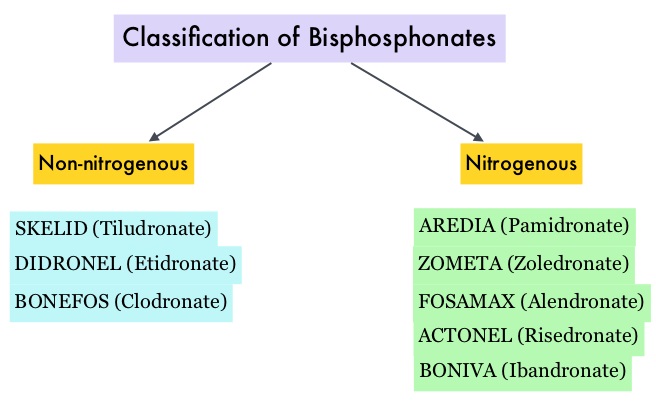 Bisphosphonates can also reduce bone pain and may improve Quality of life. Intravenous bisphosphonates, Pamidronate (AREDIA®) and Zoledronic acid (ZOMETA®) have been approved in the US for the treatment of bone metastases. Amino-bisphosphonate, ZOMETA® has however largely replaced AREDIA®, because of its superior efficacy. Both AREDIA® and ZOMETA® are administered IV every 3 to 4 weeks during the first year, following diagnoses of bone metastases. However, the optimal treatment schedule following this initial phase of treatment has remained unclear. Further, renal toxicity, long bone fractures and OsteoNecrosis of the Jaw (ONJ) have been identified as potential problems with bisphosphonate use.
 The primary endpoint was incidence of any Skeletal Related Event (SRE) and secondary endpoints included skeletal morbidity rates, performance status, pain using the Brief Pain Inventory and incidences of ONJ and renal dysfunction. Both treatment groups were well matched. Patients in this trial were stratified by disease and analyses by disease was pre-planned. It was noted that for the primary endpoint, there was no significant difference between the two treatment groups with 29% of patients in both treatment groups experiencing at least one SRE (P=0.79). With regards to secondary endpoints, there were still no significant differences between the two treatment groups, including renal dysfunction and ONJ. The authors pointed out that toxicities such as ONJ and renal dysfunction are more likely to occur after 2 years of treatment.
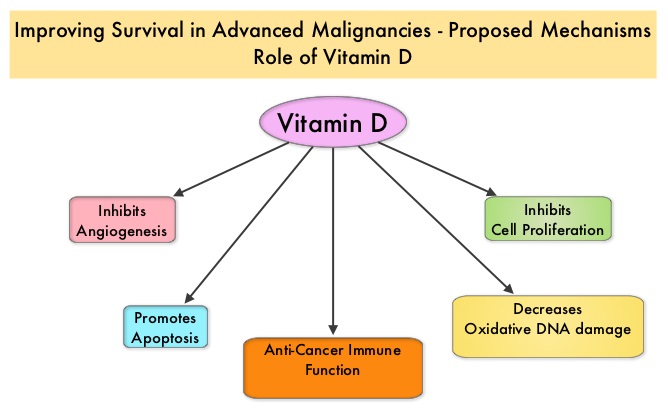 The beneficial effects of Vitamin D in malignancies has been attributed to its antiproliferative and antiangiogenic properties, as well as its effects on cell differentiation, promotion of apoptosis and its ability to decreases oxidative DNA damage. Further, macrophages play an important role in the human body’s response to therapy with monoclonal antibodies, an integral part of Follicular Lymphoma therapies and low serum Vitamin D levels may interfere with macrophage function and this may explain poor outcomes in some Follicular Lymphoma patients with low Vitamin D levels