
SUMMARY: The American Cancer Society estimates that about 61,560 new cases of kidney cancer will be diagnosed in the United States in 2015 and over 14,000 patients will die from this disease. The VHL (Von Hippel-Lindau) gene is the most frequently mutated gene (approximately 90%) in clear cell Renal Cell Carcinoma (ccRCC). The VHL gene is a tumor suppressor gene and under normal conditions with normal oxygen tension, binds to Hypoxia-Inducible Factor (HIF-1 alpha) and facilitates degradation of this factor. Under hypoxic conditions and in patients having biallelic loss of function and mutation of VHL genes, HIF-1alpha is not degraded. Build up of HIF-1 alpha results in increased angiogenesis, increased tumor cell proliferation and survival, as well as metastasis. SUTENT® (Sunitinib) is a MultiKinase Inhibitor(MKI) and simultaneously targets the tumor cell wall, vascular endothelial cell wall as well as the pericyte/fibroblast/vascular/ smooth vessel cell wall and is capable of specifically binding to tyrosine kinases, inhibiting the earlier signaling events and thereby inhibits phosphorylation of VEGF receptor, PDGF receptor, FLT-3 and c-KIT. AFINITOR® (Everolimus) unlike SUTENT® does not inhibit tyrosine kinases but is a specific inhibitor of mTOR(Mammalian Target of Rapamycin) which is a serine/threonine kinase, normally activated further downstream in the signaling cascade. With the inhibition of mTOR, protein synthesis is inhibited resulting in decreased angiogenesis, cell proliferation and survival as well as decreased levels of HIF-1 alpha. Besides VHL gene mutation, several novel relatively common mutations of histone modifying and chromatin remodeling genes have been identified in clear cell RCC, with the availability of Next Generation Sequencing (NGS). Next-generation sequencing (NGS) platforms or second-generation sequencing unlike the first-generation sequencing, known as Sanger sequencing, perform massively parallel sequencing, which allows sequencing of millions of fragments of DNA from a single sample. With this high-throughput sequencing, the entire genome can be sequenced in less than 24 hours. Some of the new genes identified include PBRM1, KDM5C, SETD2 and BAP1. These are tumor suppressor genes and are located on chromosome 3p, close to the VHL gene, at the 3p locus. Mutations involving these genes in clear cell RCC, results in loss of protein expression and has been associated with advanced tumor stage, grade and poor patient outcomes.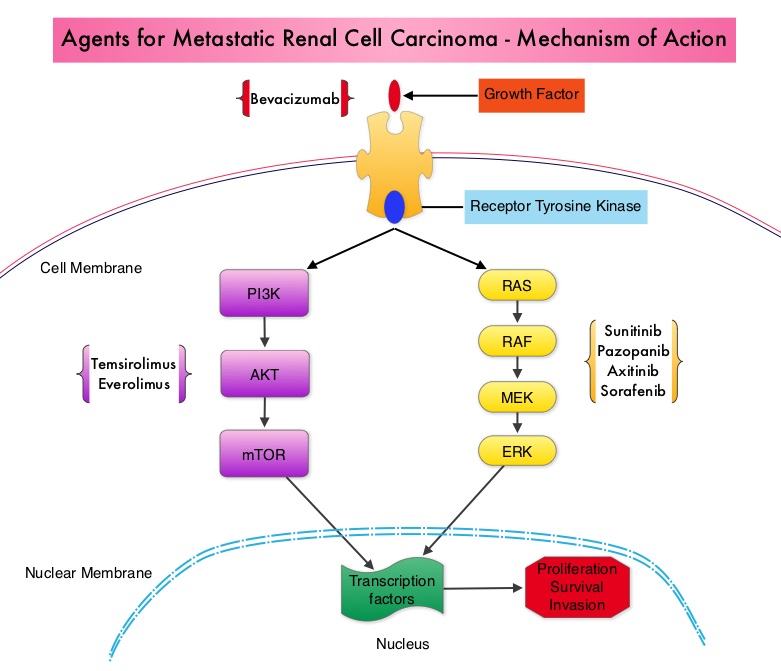
The authors in this study explored patient outcomes, based on somatic mutations and therapy given, amongst patients enrolled in the RECORD-3 trial. RECORD-3 is multicenter, randomized phase II trial which enrolled 471 treatment-naïve, metastatic, clear cell Renal Cell Carcinoma patients and compared first line AFINITOR® followed by SUTENT® at progression (N=238) with the standard sequence of first line SUTENT® followed by AFINITOR® (N=233). Using Next Generation Sequencing the authors were able to identify somatic mutations in the exons of 341 cancer related genes and associated the first line Progression Free Survival (PFS) with the tumor genotypes. They noted that 41% of the cohort of patients had PBRM1 mutations. In the group of patients receiving AFINITOR® as first line therapy, those with PBRM1 mutations had a longer median PFS compared to those who did not have PBRM1 mutations (11.1 vs 5.3 months; P=0.0031). Further, those with PBRM1 mutations, derived comparable PFS benefit from first line AFINITOR® or first line SUTENT®. In the group receiving SUTENT® as first line therapy, patients with KDM5C mutations had a longer PFS compared to those who did not have KDM5C mutations (mPFS 20.6 vs 8.4 months; P=0.0511). The authors concluded that PBRM1 and KDM5C gene mutations may predict sensitivity to mTOR or VEGFR inhibitors, in metastatic Renal Cell Carcinoma with different genomic profiles. Identification of efficacy biomarkers in a large metastatic renal cell carcinoma (mRCC) cohort through next generation sequencing (NGS): Results from RECORD-3. Hsieh J, Chen D, Wang P, et al. J Clin Oncol 33, 2015 (suppl; abstr 4509)
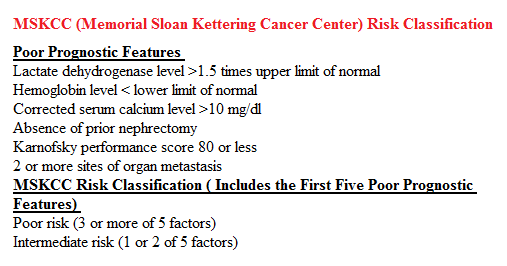
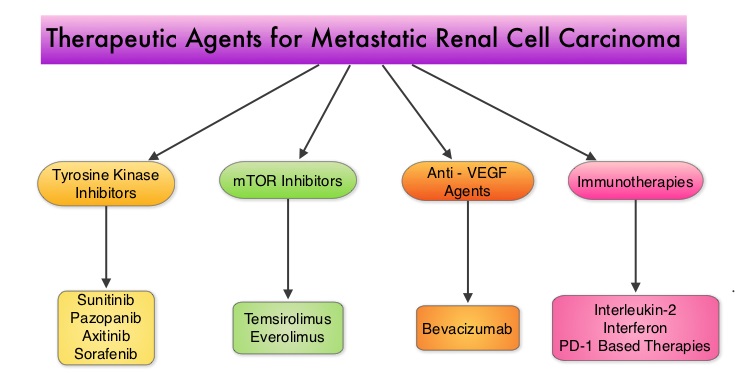 The understanding of the biology of clear cell carcinoma of the kidney has led to the development of multitargeted Tyrosine Kinase Inhibitors, which are small molecules that simultaneously target the tumor cell wall, vascular endothelial cell wall as well as the pericyte/fibroblast/vascular/ smooth vessel cell wall. The end result is decreased angiogenesis, cell proliferation and cell survival of both endothelial cells as well as tumor cells. There are four classes of agents presently available for the treatment of metastatic Renal Cell carcinoma. They include Immunotherapies, Anti-VEGF agents, Tyrosine Kinase Inhibitors (TKI’s) and mTOR (Mammalian Target of Rapamycin) inhibitors. The choice of First Line therapies for metastatic Renal Cell Carcinoma is based on MSKCC (Memorial Sloan Kettering Cancer Center) risk classification and the agents include, Temsirolimus (TORISEL®) for poor risk patients and TKI’s as well as Immunotherapy with or without anti-VEGF agents for good and intermediate risk patients.
 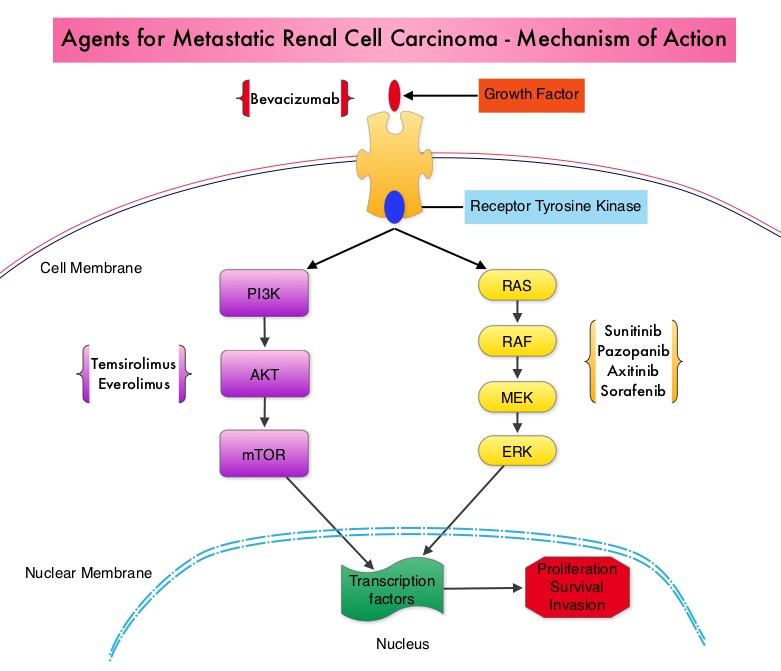 The TKI’s of choice however for good to intermediate risk mRCC patients with clear cell histology are, either SUTENT® (Sunitinib) or VOTRIENT® (Pazopanib). Even though both agents have similar efficacy, it remained unclear if one agent was better tolerated than the other. To address this, the authors evaluated patient preference for VOTRIENT® or SUTENT® in a double blind, phase III cross over study. The primary end point of this study was patient preference for a specific treatment, as assessed by a questionnaire at the end of the two treatment periods. Other endpoints included reasons for preference, physician preference, safety, and HRQoL (Health Related Quality of Life). Randomly assigned patients with metastatic Renal Cell Carcinoma (mRCC) with clear cell histology (N=168), received VOTRIENT® 800 mg per day for 10 weeks followed by a 2 week washout period and then SUTENT® 50 mg per day (4 weeks on, 2 weeks off, 4 weeks on) for 10 weeks (N=86), or the reverse sequence (N=82). One hundred and fourteen (N=114) patients met the prespecified modified intent-to-treat criteria for the primary analysis and the criteria included exposure to both of the treatments, no disease progression before cross over and completion of the preference questionnaire. When outcomes were evaluated, 70% of the patients preferred VOTRIENT®, 22% preferred SUTENT® and 8% had no preference (P<0.001).
  The main reasons for preferring VOTRIENT® were less fatigue and better overall quality of life whereas those who preferred SUTENT® cited less diarrhea as the main reason. Physician preference was also taken into consideration in this study, as physicians are able to better assess efficacy and asymptomatic toxicities that are clinically relevant. VOTRIENT® was preferred by 61% of the physicians, 22% preferred SUTENT® and 17% had no preference. VOTRIENT® was also superior to SUTENT® with regards to HRQoL measures that evaluated fatigue, hand/foot soreness and mouth/throat soreness. The authors concluded that this innovative cross-over trial demonstrated that significantly more patients preferred VOTRIENT® over SUTENT®, based on lower rates of adverse events and better Health-Related Quality of Life. Escudier B, Porta C, Bono P, et al. J Clin Oncol 2014;32:1412-1418